Sunday, 31 August 2014

CONCEPT: Blog entry 45


DONE! This one has turned out much better than the others, and I proved that I can do this in a day. If I can do this in a day, I know that I will have the time to make one for each of the species on the R.L next semester for my outcome. Although this isn't as detailed as I'd like it to be. Theres only 5 images that make up the pattern. The background pattern works really well, I think because theres so many different images that make it up. what I have been are just little experiments to see what works, but next time I want to try making the stamps bigger with more detail. 

Experimentation with pattern - White-tailed eagle

Experimentation with pattern - White-tailed eagle
White-tailed eagle pattern stamp

I spent more time playing with the composition on this one, to try and get it right. After looking at lots of other patterns the other day, with this one I tried to make sure that everything was equally spaced, I also tried to make sure that everything was spread further apart, with the hopes that it might make the pattern flow better.


I think this attempt has been the most successful so far. Each one I do they get a little bit better. I cant wait to really get stuck into this next semester.


CONCEPT: Blog entry 44


This is the background pattern that I made for the white tailed-eagle pattern, made up of all the prey that it might eat. All the images of the eagle that I've been working on today will go over the top of this to make up the main pattern. 


CONCEPT: Blog entry 43

I wanted to have one final bash at a pattern before hand in, and theres a couple of ideas for back grounds that I think will make this work better...

so, starting from scratch, with the white-tailed eagle. I wanted to do this one because it's slightly different from the few that Ive done so far, and I wanted to show more how I could incorporate the food aspect of this idea.

Here are some of my initial drawings that will go make up the final pattern;


White-tailed eagle

White-tailed eagle
From all my past experimentations, I discovered that when the bird is all one colour, it is best to use a couple of shades of that colour, instead of just the one colour, like I am able to do with the other more colourful species...these I just use the different colours to give the impression of the shape of the bird. when they are just one colour, if I only use one colour, they lose their shape and definition and look rubbish, so a couple of shades of the same colour help give it back some of that definition, but I still want to keep it to as few colours as possible.


White-tailed eagle
White-tailed eagle

White-tailed eagle

Thursday, 28 August 2014

CONCEPT: Blog entry 42

Once again, I've taken to Pinterest for ideas;


I've been trying to work out how to get around the problem of my pattern having gaps in it (it's really annoying me). So I thought that looking at lots of other different patterns might help. It has kind of...But I think the only way to stop this from happening, its to make a section, see how it works, and then go back to it, and keep working it like that. It's going to require some patience, something which I have none of. I also think I need to make more little bits to fill up spaces...I can use this to my advantage by adding little things like flowers and food (rabbits, insects, berries) to give more information, but to also make my pattern flow better.
CONCEPT: Blog entry 41

AS part of my research, I decided to look in to what else there is around the red list...books, articles etc. In my previous research I had found a couple of books, one of them being While Flocks Last by Charlie Elder (Elder 2009) which focuses on one mans journey to track down all of the birds on the Red List. Although this book works as a story of Elder's life for the year that he spent finding all of the birds, it does offer a lot of information on each bird, and why they are on the Red List. Also there was the RSPB bird guide itself which highlights which species belong to the red, amber and green categories - I also found this feature in another bird guide; The Kids' Book of Garden Birds (Sahai, 2013). There is also a small book of poetry about the Red List, The Red List: A Poem (Cushman, n.d.), but, apart from these few examples, I haven't found any other books that reference the Red List - never mind a guide book that focuses entirely on the Red list.
Like wise, I wasn't able to find many articles on the subject, just a couple from around the time the RSPB announced the Red List. There is this one (Adam, 2009) on the guardian...but there is very little on the Red list.

This project will serve to fill that gap. It will offer more information on the Red List itself, and also the birds, but not just the information on the species, like most other guides, but why they are featured on the Red List, and why it matters. I want it to spread the word, and make more people bothered about this. I need to find away to give the subject a wide appeal; I'm hoping that I can do this through my style of illustration.


Adam, D. (2009). Cuckoo joins official list of UK's most endangered birds. [online] the Guardian. Available at: http://www.theguardian.com/environment/2009/may/28/cuckoo-endangered-bird-species [Accessed 27 Aug. 2014].

Cushman, S. (n.d.). The red list. 1st ed.

Elder, C. (2009). While flocks last. 1st ed. Oxford: ISIS.

Sahai, S. (2013). The Kids' Book of Garden Birds. 1st ed. Square and Circus.


Wednesday, 27 August 2014

CONCEPT: Blog entry 40

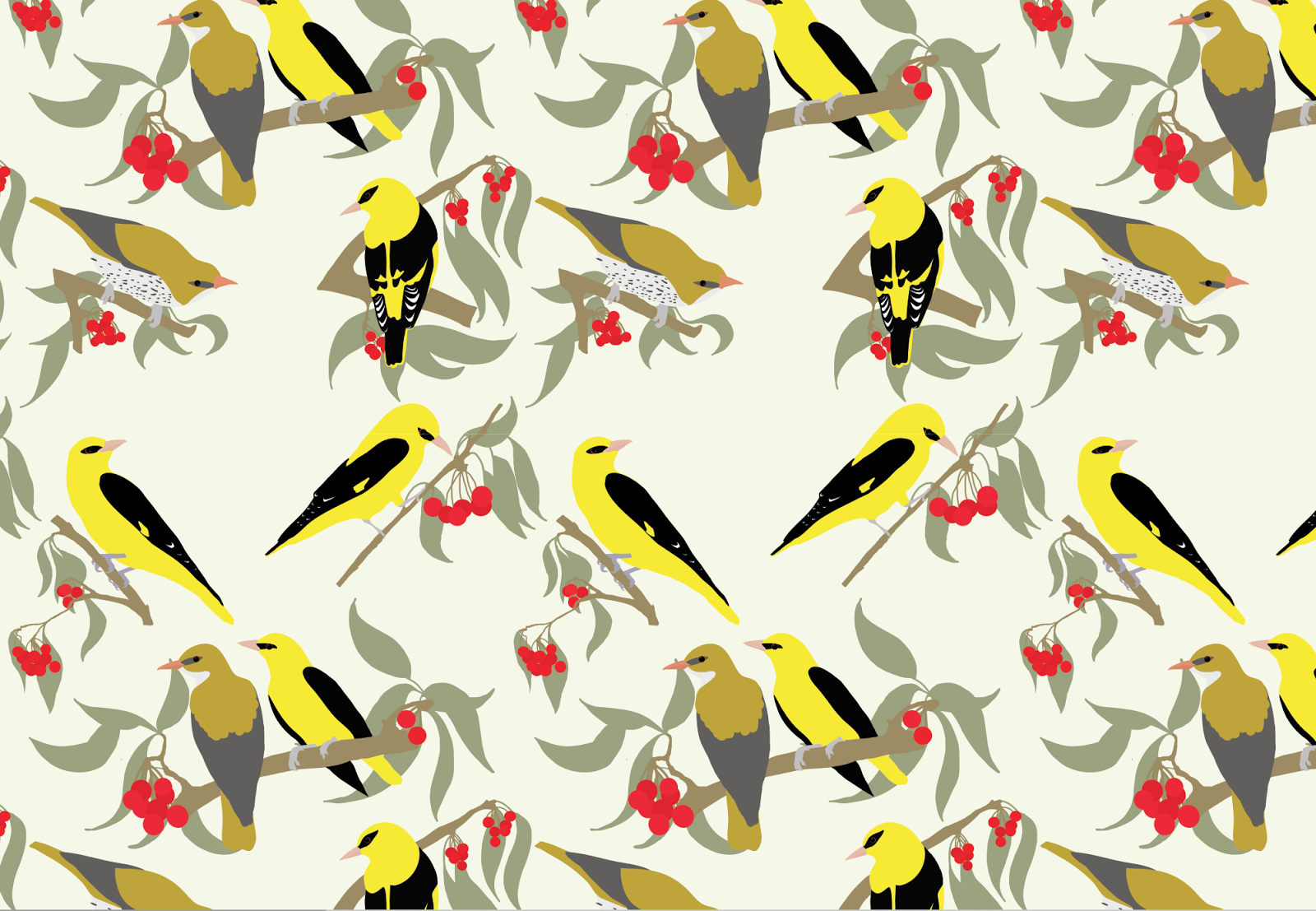
Today I have spent most of my day working on this pattern, with golden orioles all over it. I wanted to use this example of more how I can mix in more information about the bird (although this particular species may have been a poor choice in hindsight) but you get the gist...I have used both the male and female variations of the bird, and the branches it sits upon are those of the tree where it's favourite berries grow. The also eat insects, but I was unsure how/whether to include this (??).
Experimentation in Photoshop, Golden Oriole Pattern
[As you can see here, it doesn't quite seamlessly repeat yet, but it's getting there! - I'll talk about this a little more in a moment]

Experimentation in Photoshop, Golden Oriole Pattern, Detail

Experimentation with pattern - Holes!
As this image shows, although this attempt at a repeating pattern was more successful, I still have noticeable holes! It is only my second attempt using this method, but I wanted to have at least one nicely done example before I hand my work in. sadly though, this has taken me the best part of a day, and it is no where near as nicely polished as I would like it to be...
I may just have a to accept that I haven't got time to be able to nail this technique before assessment..which is pretty pants.
HOWEVER! It does work, I just need to work on it and get better at it; my second attempt is already lots better than my first, I don't think it will take that long for me to get the hang of it. 
It does work, it just needs lots more experimentation and polishing, which I will have time for in the next module, I just haven't had time for it in this module because I've been too busy pulling my hair out figuring out what I'm actually going to do.

Tuesday, 19 August 2014

CONCEPT: Blog entry 39


For this one, I actually found out how to make a proper repeating pattern - as a result, it works much better. It's not as nicely finished as I'd like (I've been at this all day, I'm packing up after this post) the leaves look horrid, I'll have to find a better way to do these next time, but for today I just wanted to see if I could do this.

[This is the tutorial I followed to make my pattern]

Experimentation with pattern in Photoshop - Marsh Tit


Experimentation with pattern in Photoshop - Marsh Tit detail
Another part of the plan, was to make  the pattern relate to the birds habitat, which I haven't done here (time, and I'm just fannying around), I did try to do this more with my previous pattern with the lapwings (showed it's nest, tried to convey the idea of water etc.) with the smaller birds I'm thinking of using the trees that they like to hang out in... and it will generally flow better when I have them all together (it will be more obvious what I'm doing, I hope, anyway) for instance, the wader birds will be around water, on sand, marshes. Game birds (capercallie, grey partridge etc.) will be on the ground, autumnal colours and leaves, and the smaller birds will have their favourite trees (foods, berries etc.) I just think its a more interesting way to show the birds habitat that the traditional images found in these kinds of books.

I really like this idea...but, how is it relevant to the RSPB Red List? Why should it be a pattern?
Well; (a couple of ideas..)
- Patterns are fashionable, a way to appeal to a wider audience 
- Book could link to a website, where can buy things with that print on, with a portion of the proceeds going to the RSPB (I have other ideas for a website too, later though).

(Although these two ideas are making it very female orientated - can you make a butch pattern??)

I'm just thinking of trying to do something different with the illustrations! As my research yesterday proved, there are so many arty bird books, full of very similar looking pretty water colours of birds and animals - I need to find something different to make mine stand out.

___________________________

I've been thinking about what I might put in my PPF...and what I will actually be making. Right now, I'm thinking it will be a book (on the Red List, obvs). I want the book be a combination of the two main types of bird books; the species guide and the arty coffee table book, with a wide audience appeal. I want it to provide information on the Red List and the individual species, like the species guide, but I also want it to have the appeal of the coffee table books. 

I've also been thinking that this book can then link to website; the website will have a couple of features,
- More info on each species (sound clips, photos)
- Sighting maps that can be added too - can see where the birds of the Red List have been spotted
- Shop! for the patterns, proceeds going to the RSPB


There is much more work to be done on this...but my idea is coming together! (Its about bloody time too!)