This is just some brief continuation of my experimentation with this idea. For this one I've been thinking more along the lines of a logo (although this would be something that is also part of the main pattern). I think these work better than those of the sparrows, but mainly because the capercaillie has a more recognisable shape.
There is still a lot more to experiment with with this idea;
-full pattern overlay
-emulsion printed backgrounds
-other types of printed backgrounds
-working into photos by hand (? sewing, painting, drawing)
-different variations of image
I also still want to continue to experiment with how simple my designs are going to be, and I need to work on refining the birds them selves too.
REALISATION: Blog entry 8
Experimentation photoshop - sparrows
This image is just another little bit of experimentation carried on from before, with spots and dots and just trying little things that I might be able to incorporate into the layers of my pattern. I've also been thinking about how Mel Lim takes small aspects of her patterns and uses it on a range of things..I think this is something that I should be thinking of as, I'm not sure what exactly my outcome will be, but I'm currently thinking that I will be a range of things, all tied together by one pattern. Using small aspects of the design on different things is a good way to connect them all together under one project.
I have been looking into the active projects by the RSPB to get more information on the issues surrounding sparrows, to get a better grasp on what gap my project could fill;
Recent research has shown house sparrows in
urban areas suffer from a lack of invertebrates (insects) to feed their young.
This was shown by a study in Leicester, where poor condition and death of young
chicks was linked to low numbers of invertebrates in their diet (RSPB and De
Montfort University study). A large-scale feeding experiment in London (RSPB
study) has demonstrated the importance of invertebrates for the survival of
young chicks. Through this project, we tested more natural ways to increase the
numbers of invertebrates available to sparrows and other birds in our urban
green spaces.
The
London House Sparrow Parks Project tested different habitat management types in
London parks with the aim of boosting invertebrate numbers and also seeds
during the winter. This could benefit a host of urban birds, insects and other
wildlife.
Project objectives
To test which of the following habitat management types benefit
house sparrows and other species the most: (1) long grass (left to set seed
over winter); (2) native wildflower meadows (with traditional haymeadow
management); (3) 'Wildlife seed plots' (based on wild bird cover options of the
Environmental Stewardship Scheme for farmland).
To provide advice to parks across London and the UK, based on the
results
To raise awareness of the problems facing urban wildlife and
encourage people to consider wildlife in local parks and their own gardens
Key dates so far
25 trial plots (and corresponding 'control' plots of normal park
management) were set up in 20 parks across London
Three years of monitoring have been completed (bird, insect and
seed numbers)
A team of forty dedicated volunteers helped to monitor bird use of
the plots during the project
Public engagement and educational activities were carried out at
and near some of the parks
Results have been analysed and papers will be written up to make
the results widely available
(The RSPB, 2014)
However, I still have more research to do;
-More into individual projects and what they actually were! (info on RSPB website is pretty vague)
-Research into invertebrates (suspected main cause for species decline)
-Other sparrow research (history/symbolism/etc..)
Hopefully doing more research will give me the fuel I need to become more productive.
I'm having an ideas dry spell, and am not sure what to make or where to go with anything at the moment..I think I've been too focused on having to have my stuff together for the upcoming concept panel, and also trying to figure out what my outcome maybe (which I of course wont know t the moment but I cant help but think about it...) so I decided to just brain storm, and have a couple of days just experimenting and see what come from it.
Photoshop experimentation - Urban Sparrows
This is just a random idea that I thought I'd try. I wanted to experiment with taking elements of my pattern and applying it in different ways, to different things..this was just a quick experiment with that (I intend to do more with this). I also had the idea to try a really simplified version of the style that I have been working with; I wanted to see if it would be possible to reduce it to one colour. I think this may work with a more recognisable bird (such as the capercaillie, which I'm going to try this with next) but with the sparrow, I just don't think that it is recognisable as that...so this kind of flops. The idea of using the photographs works (not my image by the way, just one from google for the sake of experimentation) to give a good idea of the location, and possibly the issue at hand. Overall though i'm not sure this idea works too well..but I will also try this, and some more variations with capercaillie, and the forest to see how that works. I will also try a couple more variations of this idea with sparrow and the city, although I'm not convinced by the idea anymore...
The RSPB, (2014). London House Sparrow Parks Project. [online] Available at: http://www.rspb.org.uk/whatwedo/projects/details.aspx?id=tcm:9-235650 [Accessed 9 Oct. 2014].
Thursday, 28 August 2014
CONCEPT: Blog entry 41
AS part of my research, I decided to look in to what else there is around the red list...books, articles etc. In my previous research I had found a couple of books, one of them being While Flocks Last by Charlie Elder (Elder 2009) which focuses on one mans journey to track down all of the birds on the Red List. Although this book works as a story of Elder's life for the year that he spent finding all of the birds, it does offer a lot of information on each bird, and why they are on the Red List. Also there was the RSPB bird guide itself which highlights which species belong to the red, amber and green categories - I also found this feature in another bird guide; The Kids' Book of Garden Birds (Sahai, 2013). There is also a small book of poetry about the Red List, The Red List: A Poem(Cushman, n.d.), but, apart from these few examples, I haven't found any other books that reference the Red List - never mind a guide book that focuses entirely on the Red list.
Like wise, I wasn't able to find many articles on the subject, just a couple from around the time the RSPB announced the Red List. There is this one (Adam, 2009) on the guardian...but there is very little on the Red list.
This project will serve to fill that gap. It will offer more information on the Red List itself, and also the birds, but not just the information on the species, like most other guides, but why they are featured on the Red List, and why it matters. I want it to spread the word, and make more people bothered about this. I need to find away to give the subject a wide appeal; I'm hoping that I can do this through my style of illustration.
Adam, D. (2009). Cuckoo joins official list of UK's most endangered birds. [online] the Guardian. Available at: http://www.theguardian.com/environment/2009/may/28/cuckoo-endangered-bird-species [Accessed 27 Aug. 2014].
Cushman, S. (n.d.). The red list. 1st ed.
Elder, C. (2009). While flocks last. 1st ed. Oxford: ISIS.
Sahai, S. (2013). The Kids' Book of Garden Birds. 1st ed. Square and Circus.
Wednesday, 27 August 2014
CONCEPT: Blog entry 40
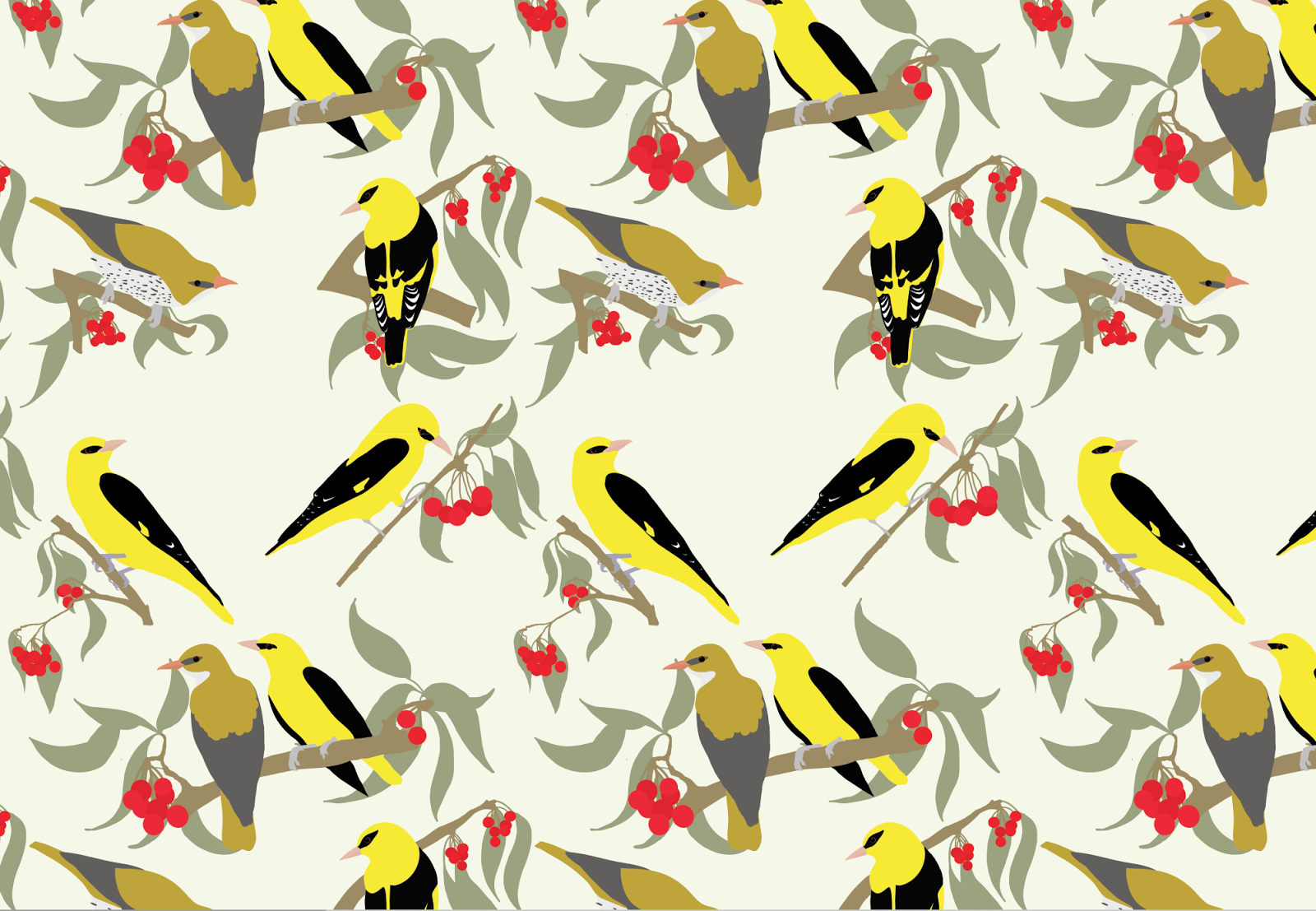
Today I have spent most of my day working on this pattern, with golden orioles all over it. I wanted to use this example of more how I can mix in more information about the bird (although this particular species may have been a poor choice in hindsight) but you get the gist...I have used both the male and female variations of the bird, and the branches it sits upon are those of the tree where it's favourite berries grow. The also eat insects, but I was unsure how/whether to include this (??).
Experimentation in Photoshop, Golden Oriole Pattern
[As you can see here, it doesn't quite seamlessly repeat yet, but it's getting there! - I'll talk about this a little more in a moment]
Experimentation in Photoshop, Golden Oriole Pattern, Detail
Experimentation with pattern - Holes!
As this image shows, although this attempt at a repeating pattern was more successful, I still have noticeable holes! It is only my second attempt using this method, but I wanted to have at least one nicely done example before I hand my work in. sadly though, this has taken me the best part of a day, and it is no where near as nicely polished as I would like it to be...
I may just have a to accept that I haven't got time to be able to nail this technique before assessment..which is pretty pants.
HOWEVER! It does work, I just need to work on it and get better at it; my second attempt is already lots better than my first, I don't think it will take that long for me to get the hang of it.
It does work, it just needs lots more experimentation and polishing, which I will have time for in the next module, I just haven't had time for it in this module because I've been too busy pulling my hair out figuring out what I'm actually going to do.
Monday, 18 August 2014
CONCEPT : Blog entry 37 As well as looking at various books that are knocking around, I've been looking at the Red List on the RSPB's website (The RSPB, 2014). And I've been thinning about what my book could look like..what to include, how it would work. I want it to function as a guide, and with the information on the Red List but also to appeal to a wide audience, I think I've given up on appealing to children really, but younger adults, just more people outside of the hardcore twitchers, and I'm thinking of all the ways in which I could do this.
I have been thinking about doing a print/pattern for each bird...this could be something a little different. This idea comes from a love of Cath Kidston, but also thinks like William Morris prints, John Ruskin, and Timerous Besties. This kind of vintage pattern is making a come back and can be utilised to appeal to the wider audience that I am wanting it too...If I really wanted to go made I could have some of my patterns printed to fabric and make some bits an bobs too (just something to think about - materials to go along side a book).
The patterns would include bits of information about each species, like links to their habitat and location in the county.
Cath Kidston - Garden Birds Pattern
Timorous Beasties Pattern
William Morris pattern
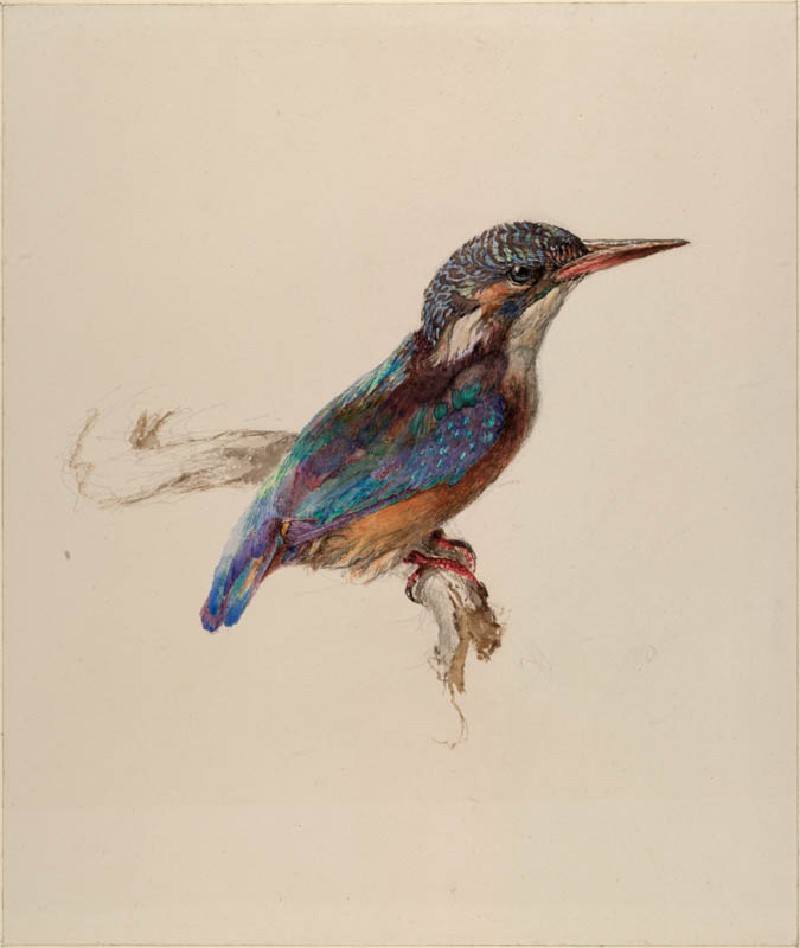
John Ruskin Study of Kingfisher 1871
With my dissertation pretty much finished, I can focus on this idea, and get back to making things, and see what I can make work! I'm excited to get making things again.
The RSPB, (2014). Red, amber and green explained. [online] Available at: http://www.rspb.org.uk/wildlife/birdguide/status_explained.aspx [Accessed 18 Aug. 2014].
Tuesday, 15 July 2014
CONCEPT : Blog entry 28
Feedback from PPF:
- Rethink title [The art of the species guide in conservation] does the guide have a role in conservation?
- More research (primary, secondary)
- Include all research in bibliography, not just the thing referenced.
- More artists
- Improve rational - narrative; what I did, where I came from, my conclusions, how that has influenced my ideas for this module.
- Reference: what have I looked at in terms of guides?
- Be specific with references (all references - Sam Winston??)
- Current RSPB campaigns (Home for wildlife)
- Local community wildlife groups
- Audience? (TBD)
- Outcome? (TBD)
- Boyle Family - forensic recreation of a place, land art
From this video, you can then go to the website and find a range of guides on how to 'give nature a home'. Below is the main guide, avaliable to recieve through the post or as a pdf, but there are also guide for how to make dead wood piles, build a home for bats, and create nature corridors, as well as lots of different activities to help bring nature into your garden (RSPB: GIVING NATURE A HOME, 2014).
Give nature a home Guide - RSPB
(RSPB: GIVING NATURE A HOME, 2014)
One of the thing Tim suggested I do to help my research and development of my concept, was to dissect the guides that are already out there. I am unsure if it is a guide book that I will produce, but getting to grips with what is already available, and finding the problems with it will help me figure out what it is I am wanting to do. I've also ordered a physical copy of this so I can look at it and analyse it properly in my sketch book; I also intend to do this with a couple of other guide books too.
I really like what the RSPB are trying to do with this campaign; by getting everyone to pitch in and create a better habitat for wild life in their own back garden, this helps with conservation on a much wider scale, at a much lower cost for them. Although the RSPB is primarily for birds, by getting people to make a better environment for plants, insects and other wildlife, it creates a better environment for the birds, and makes their survival much easier.
My only problem with it it, is it seems to be aimed towards adults. which is fine, in theory. It provides them with activities to do with their children, but non of the material is aimed at children.
So...for example, I could have been looking at all this, and decide that one Sunday afternoon me and the kids are going to build a wood pile to attract lots of insects; I can download a simple little guide telling me exactly how to do this - this guide is really simple, no images, just the instructions; not appealing to children at all.
If I were to remake this I would have it as something to show the kids, to get them interested too. "If we build a log pile, look at all the cool insects that will come and live in it!" and maybe some kind of treasure hunt list, to keep them coming back to check and see what insects move in.
I think one of biggest parts of conservation should be to educate and build interest in younger people, so that in the future they think of things like our wildlife, and try to help.
And with the main guide that I have shown in this post. It is very simple, and too the point, with lots of good information on what you can do to help, but only focuses on adults.
[This guide also uses, what I thought was one of my ideas, to use the silhouette of the animal with a photograph of it natural habitat...I swear I'm thinking of these things first!]
I have been thinking about focusing on a specific location for my 'guide', as I think this will narrow down what needs to be included. 'Wild life' is just too broad, I need some kind of limit, such as 'red list', 'nature reserve', or even 'garden'. I really like the idea of focusing on your garden, getting every one to do their bit.
RSPB, (2014). [video] Available at: https://www.youtube.com/watch?v=Xc-qlIWG_4E [Accessed 15 Jul. 2014].
RSPB: GIVING NATURE A HOME, (2014).RSPB: RSPB Giving nature a home. [online] Available at: http://homes.rspb.org.uk/page/projects [Accessed 15 Jul. 2014].
RSPB: GIVING NATURE A HOME, (2014).RSPB: RSPB Giving nature a home. [online] Available at: http://homes.rspb.org.uk/?gclid=Cj0KEQjwopOeBRC1ndXgnuvx8JYBEiQAq4RPt2v59IpYPBWklX00z16zgAsLTLJC2887yg0e7PDhRiwaAo5H8P8HAQ [Accessed 15 Jul. 2014].
Thursday, 19 June 2014
CONCEPT : Blog entry 14
Have been doing some research into various guides, field handbooks;
Readers Digest Garden Birds
RSPB Pocket Birds
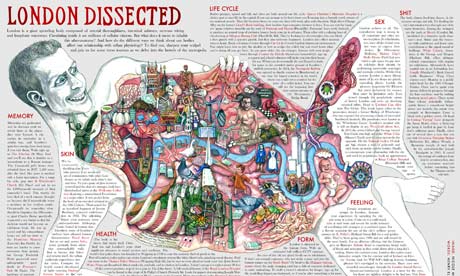
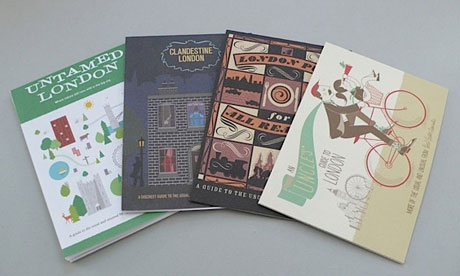
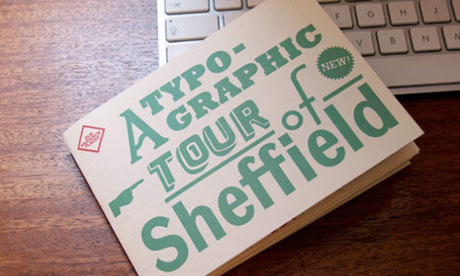
(Eliot, 2013)
Crossley ID Guide: Eastern Birds by Richard Crossley
Matt Sewell Our Garden Birds
Have also been looking at different styles of biology text book illustration;
Bibliography: Eliot, H. (2013). Beyond Lonely Planet: top 10 quirky UK guidebooks. [online] the Guardian. Available at: http://www.theguardian.com/travel/2013/jul/23/top-quirky-uk-guidebooks-print [Accessed 19 Jun. 2014].





.jpg)
.jpg)